· Letter
Your moat is thinner than you think
Originally published on Substack (opens in a new tab). Subscribe (opens in a new tab) for the next letter.
What would stop your best customer from leaving tomorrow, or from buying from someone else next week?
First, what is a moat?
A moat is whatever protects a business from its competitors, like the ditch round a castle. Warren Buffett made the picture famous, writing in his 1995 letter to Berkshire Hathaway shareholders, “In business, I look for economic castles protected by unbreachable ‘moats.’” It is why a customer can’t easily walk across the road to someone else: a price nobody can match, a brand people trust, or a product that is very hard to build.

Why AI has made technical moats so much weaker
Software used to be protected by the years and the big team it took to build. AI coding tools are wearing that away, and the clearest recent case involves Adobe.
On 3 October 2026, Brandon Thomas, founder of ArtCraft, posted on X, “I’ve vibe coded replacements to 7 of Adobe’s apps in Rust. They’re open source.” The seven include lookalikes of Photoshop, Illustrator and Premiere. Ars Technica reports he used Claude Opus 5.5 and calls them clean-room rewrites, meaning written without Adobe’s code. The Photoshop and Premiere repositories were both created on 30 September, and Photoshop’s first release is dated 2 October, so in public at least this took days, not years.
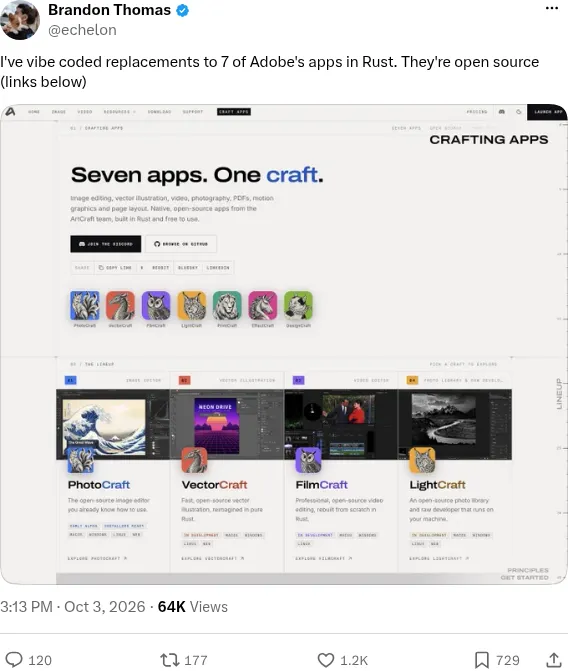
It is far from finished. Thomas calls the apps “super early alpha”, the Photoshop project’s own roadmap puts it at about 45 percent ready for real work, and testers on Hacker News were split on whether it works. What strikes me is how cheap the first copy has become.
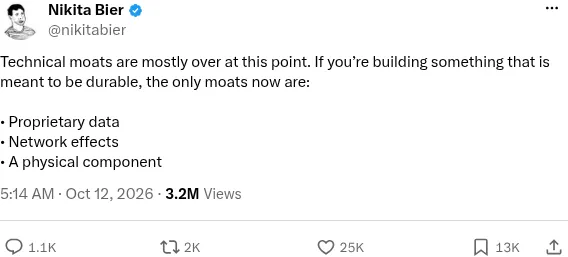
Nikita Bier made the same point on X on 12 October 2026, saying technical moats are mostly over, and that for something meant to last, the only moats left are proprietary data, network effects and a physical component.
The moat is usually thinner than we think
Most of us reach for quality or service, which is what the next supplier will say, so here is where I’ve landed. For most businesses I come across, there is little or no moat beyond helping customers get value and keeping them happy. I have tried hard to argue myself out of that view and can only partly.
Some mid-market businesses do have a real moat, such as painful switching, a contract that runs for years, or so many engineers or sites in one area that a newcomer struggles to match you. Others have a specialist skill that takes years to learn, or a licence that regulation makes hard to get. If you have one, protect it, but be honest about whether you have it or just wish you did.
What the moats thread left standing
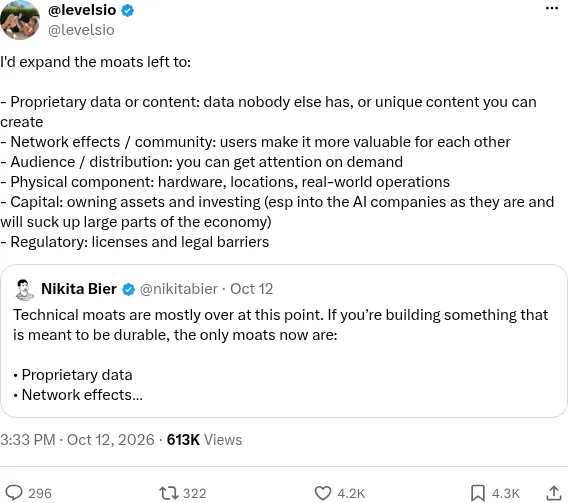
Later that day, levelsio quoted Nikita’s post and widened the list to include audience and distribution, capital, and regulatory barriers. Both are about building technology companies, so don’t stretch them.
Neither list says “customer relationships”, but in my view a customer list is a kind of proprietary data and a kind of audience. A competitor with the same tools can’t copy that by next Tuesday.
A relationship only counts if you tend it
Happy customers still leave. They drift, or someone rings them with a better price, or nobody ever asked them for more.
A moat protects the revenue you have. It doesn’t go and find you more. Behaviour does.
When I explain this, a common reply is that calling customers after they’ve used what they bought is already part of their process. I said that’s great, and asked, “Who is doing it?” There was absolute silence, because I think nobody or hardly anybody was. A line in a process document is a different thing from someone picking up the phone this week.
Customers mostly call us when something is wrong, so a call when nothing is wrong tends to surprise them.
That is where Outgrow starts. Outgrow is a revenue growth system that helps companies grow revenue 15 to 30 percent a year, organically and systematically. It starts with current customers, then past customers, prospects, past prospects and referrals. So start there: call your current customers when nothing is wrong.
Private equity leaders seem to agree that growth is where the work is. Kearney’s April 2026 survey of 100 US private equity leaders found 69 percent named revenue growth and commercial excellence as a most critical operating lever today, ahead of AI and working capital. That is what they say matters, not proof it works, and it is revenue, not EBITDA.
The first three things to say
The call takes about two minutes. Start like this.
“I was just thinking about you. How are things with the family?” If they ask whether something is wrong, tell them, “No, I’m just calling to check in on you.”
“How was the experience?” Ask this after they have used what you sold them, and then listen.
“Do you know we also do [one other thing you offer]?” Customers often see you as one thing only. If you want to go further, ask, “What else is going on in your world? Is there anything I can help you with?”
Then agree when you will speak next. That one call, made when nothing is wrong, is the start of how a business grows without chasing strangers.
I continue to build Outgrow’s UK practice, working with owners and with PE and operating partners who want organic revenue growth from the customers they already have. If that’s you, I’d be glad to connect. And if you’re curious about becoming an Outgrow advisor, say hello.
Sources
Berkshire Hathaway 1995 letter (opens in a new tab), dated 1 March 1996
Brandon Thomas on X (opens in a new tab), 3 Oct 2026
Ars Technica, “Software is over”: Bold AI developer takes aim at Adobe with open source clones (opens in a new tab), Kyle Orland, 7 Oct 2026
PhotoCraft (opens in a new tab), its roadmap (opens in a new tab), and FilmCraft (opens in a new tab)
Nikita Bier on X (opens in a new tab) and levelsio on X (opens in a new tab), both 12 Oct 2026
Kearney, “Private equity’s new rules of engagement: why operational alpha is the only durable response” (opens in a new tab), survey of 100 US private equity senior leaders, April 2026, published 4 Jun 2026
Originally published on Substack (opens in a new tab). Subscribe (opens in a new tab) for the next letter.